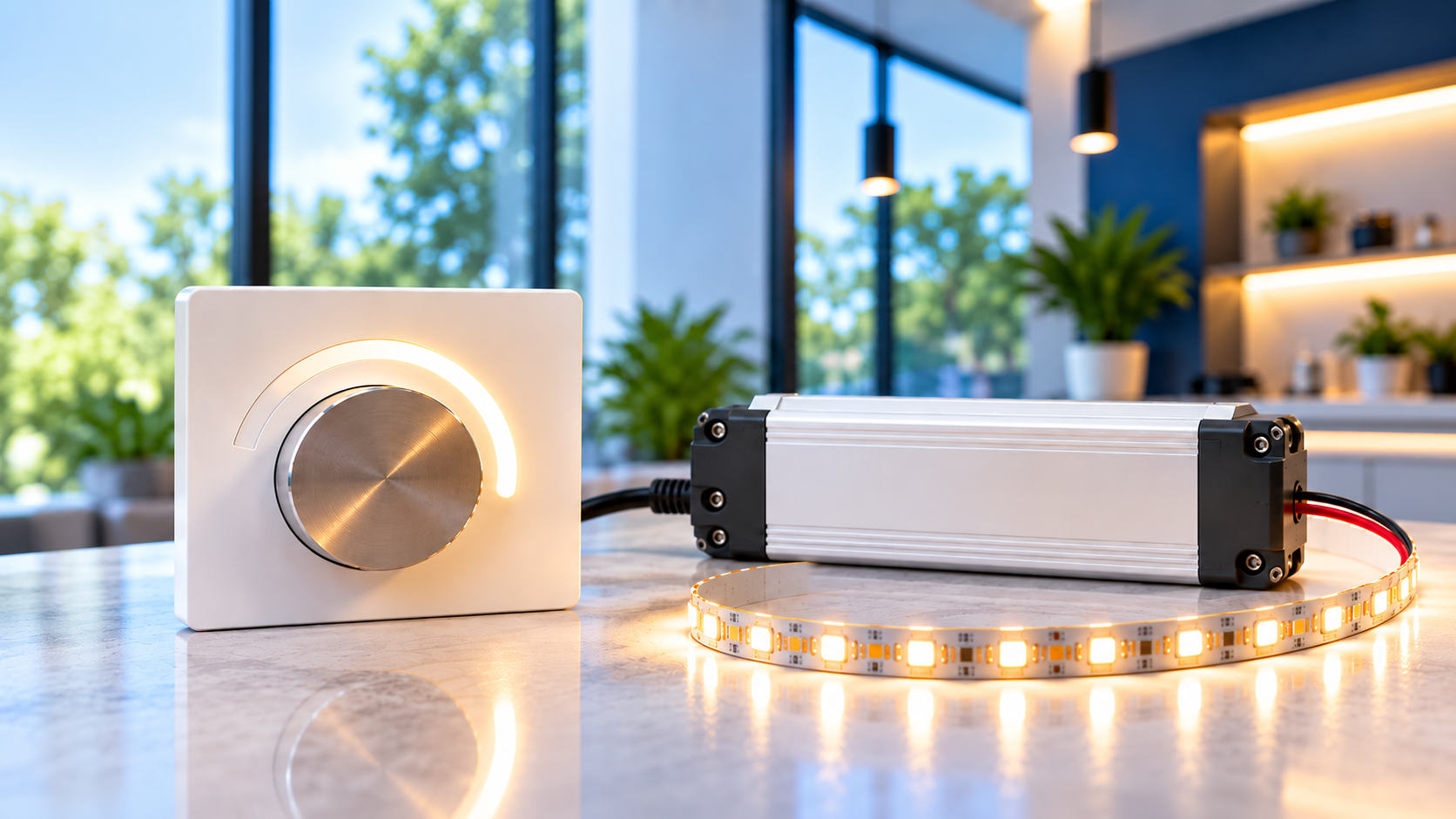
You bought "dimmable" LED fixtures, installed a dimmer, and slid it down for a relaxed evening. Instead of a warm glow, the lights shimmer, buzz, strobe on a phone camera, or cut out entirely near the bottom of the slider. Nothing is broken, and you did nothing wrong. What you're seeing is a dimmable LED driver compatibility problem: the dimmer and the driver simply aren't speaking the same language.
That is the heart of it: "dimmable" is not a single standard. A dimmable LED driver is designed to respond to one specific type of dimming signal, and a dimmer is designed to send one. When those two were chosen separately, flicker at low output is one of the most common results. The good news is that it is predictable and preventable once you know what to match.
Why does my dimmable LED driver flicker at low output?
Low-end flicker usually means the dimmer and driver were never designed to work together. Most household dimmers were built for incandescent bulbs, which act like simple resistors, much like a toaster element drawing steady, predictable current. An LED driver is an electronic power supply that converts AC line power into the controlled DC the LEDs need, and its input doesn't behave like a resistor. At low settings, that mismatch can make the dimmer switch drop out or fire unevenly, and the light output flickers. Three failure points show up most often:
- The dimmer's switch lets go. A traditional phase-cut dimmer uses a switching component (a TRIAC) that requires a minimum current to flow through it to stay "on" during each half-cycle. At low settings, an LED driver can draw less than that minimum, so the switch drops out and relights unevenly.
- The dimmer's timing circuit gets confused. Two-wire dimmers (no neutral connection) power their internal timing circuit through the lamp. They expect a resistive load, and an LED driver's input doesn't behave like one, especially as it dims. The switch then fires at the wrong moment or inconsistently, causing the light output to wobble.
- The dimmer's load rating no longer tells the whole story. A dimmer rated for 600 W of incandescent can often handle far fewer LED fixtures than the wattage math suggests, and it may also have a minimum load. Too few low-wattage fixtures on one dimmer is a classic cause of low-end flicker.
Which dimmer types work with which LED drivers?
The first rule of dimmable LED driver compatibility is simple: the driver's dimming input must match the dimmer's output type. Use this table to check the "language" before anything else. Ranges and behaviors are typical, not guaranteed; the specific driver and dimmer datasheets always win.
| Dimming protocol | How the signal travels | Driver must be rated for | Typical low-end risk | What to check |
|---|---|---|---|---|
| Forward-phase (TRIAC, leading-edge) | Dimmer chops the front of each AC half-wave on the power wires | TRIAC / forward-phase dimming | Highest: dropout, strobing, "pop-on" | Driver and dimmer both compliant with NEMA SSL 7A; the manufacturer's tested-dimmer list; minimum load |
| Reverse-phase (ELV, trailing-edge) | Dimmer chops the back of each half-wave; usually needs a neutral | ELV / reverse-phase dimming | Moderate; often smoother with electronic drivers | Neutral present; tested-dimmer list (SSL 7A does not cover ELV) |
| 0-10V analog | Separate low-voltage purple/gray wire pair; power wires stay full-wave | 0-10V input (current sinking) | Low, but the driver sets its own floor | Driver's minimum dim level (varies by driver, from about 10% down to 1% or lower); whether it dims to off or needs a switch; low-voltage wiring separation |
| DALI (digital) | Two-wire digital bus; each driver addressed individually | DALI (IEC 62386) | Low; digital commands set exact levels | Correct device type and addressing; bus power supply; programming |
| PWM / DMX512 | Digital pulses or DMX data drive a decoder or constant-voltage driver | Matching PWM or DMX input | Depends on pulse frequency | PWM frequency high enough to avoid visible and camera flicker |
At a glance: three checks against flicker
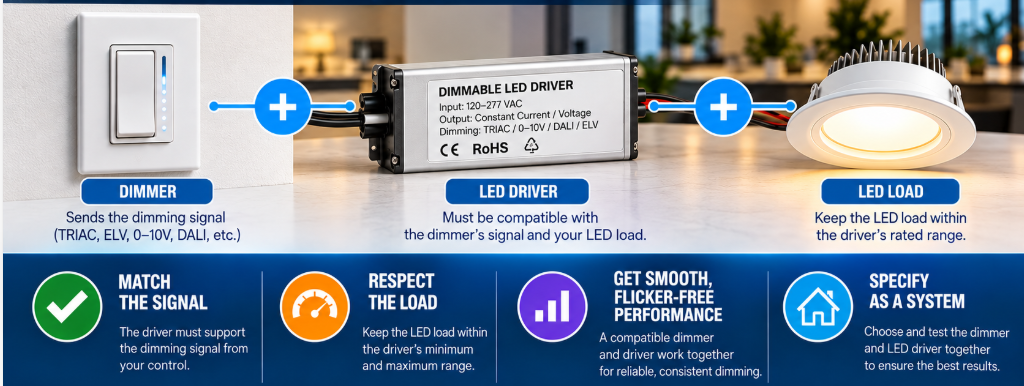
Every fix below falls under one of these three checks. Match the signal first; the other two only help once the dimmer and driver speak the same language.
How do I stop LED lights from flickering when dimmed?
Confirm the dimmer and driver use the same dimming protocol, then check the dimmer's LED load rating and minimum load. If flicker remains at the bottom of the range, raise the dimmer's low-end trim until it stops. Test one circuit before a full install, because results vary from pairing to pairing.
For homeowners and DIYers upgrading existing dimmers
- Check the driver or fixture's tested-dimmer list. Most driver manufacturers publish one. If your dimmer isn't on it, treat the pairing as unproven, not "probably fine."
- Look for an adjustable low-end trim. Many LED-rated dimmers have a small dial or programming mode that raises the bottom of the range. Setting it just above the point where flicker starts is often the quickest fix.
- Don't mix brands or models on one dimmer. Different drivers react differently to the same signal, so one fixture may flicker while its neighbor is fine.
- Replace old incandescent dimmers. If the dimmer predates your LEDs, an LED-rated model is usually the most reliable fix.
For electricians and contractors
- Derate the dimmer for LED loads. Follow the dimmer maker's LED rating, not its incandescent-wattage rating, and check both the maximum and minimum load.
- Prefer dimmers with a neutral connection where the manufacturer recommends them, so the dimmer's timing circuit isn't powered through the LED load.
- Mock up one circuit before full installation. DOE's testing showed LED dimming behavior varies from pairing to pairing, so a quick field test is cheap insurance.
For lighting designers and fixture manufacturers
- Specify the dimmer and driver on the same line of the schedule. DOE's specifier guidance recommends pairing an SSL 7A-compliant dimmer with compliant LED sources for wall-box phase-cut installations.
- Choose 0-10V or DALI when deep dimming matters. Separating the control signal from the power wiring removes the phase-cut failure modes entirely, though the driver's own minimum level still applies.
- Publish the minimum dim level and flicker data. NEMA 77 provides test methods for temporal light artifacts, giving specifiers a common yardstick.
The bottom line: specify the pair, not the part
Flicker at low output is rarely a sign of a defective product. It is usually two good products that were never meant to work together. Keep these takeaways in mind:
- "Dimmable" isn't enough. Match the driver's dimming input to the dimmer's protocol first.
- Phase-cut dimming is the riskiest pairing. Look for NEMA SSL 7A compliance on both sides and the manufacturer's tested-dimmer list.
- Respect the load. Use LED ratings, watch minimum load, and avoid mixing drivers on one dimmer.
- Tune the low end. A trim adjustment or a driver's published minimum level often explains and fixes bottom-of-range flicker.
- Test before you commit. Results vary by pairing, so a one-circuit mock-up beats a whole-house callback.
If you are planning a new installation or a fixture design, choose the dimmer and the driver in the same conversation. Ask your supplier for the driver's dimming protocol, minimum dim level, and a list of tested dimmers before you order. A few minutes of checking up front is the difference between lighting you tolerate and lighting you enjoy.
Frequently asked questions
What is dimmable LED driver compatibility?
Dimmable LED driver compatibility means the driver's dimming input matches the dimmer's signal, and the pairing has been tested to dim smoothly. A driver labeled "dimmable" responds to one protocol, such as TRIAC, ELV, 0-10V, or DALI. If the dimmer uses a different protocol, or an untested model of the same one, expect flicker or dropout.
Can I use my old incandescent dimmer with LED drivers?
Sometimes, but it is the most common cause of low-end flicker. Older dimmers were designed for resistive incandescent loads and often need more current than LED drivers draw at low settings. Check the driver's tested-dimmer list first. If the dimmer isn't on it, replacing it with an LED-rated dimmer is usually the most reliable fix.
What is NEMA SSL 7A?
NEMA SSL 7A is a U.S. standard that sets basic compatibility requirements for forward-phase (TRIAC) dimmers used with dimmable LED light engines. When both the dimmer and the LED product comply, they should work together without testing every pairing. It does not cover reverse-phase (ELV) or 0-10V dimmers, which instead rely on manufacturer testing.
Is 0-10V dimming better than TRIAC dimming for LEDs?
For smooth low-end performance, 0-10V is usually more predictable because the dimming signal travels on dedicated low-voltage wires, separate from the power. That removes the TRIAC dropout and timing problems behind most phase-cut flicker. The tradeoff is extra wiring, and the driver's own minimum dim level, which varies from about 10% down to 1% or lower, still sets how low it goes.
Why do my LED lights flicker only at the lowest dimmer setting?
At the bottom of the range, a phase-cut dimmer passes very little current, and an LED driver may draw less than the dimmer's switch needs to stay on. The switch drops out and re-fires unevenly, which you see as flicker. Raising the dimmer's low-end trim, checking the minimum load, or choosing a compatible dimmer usually solves the issue.