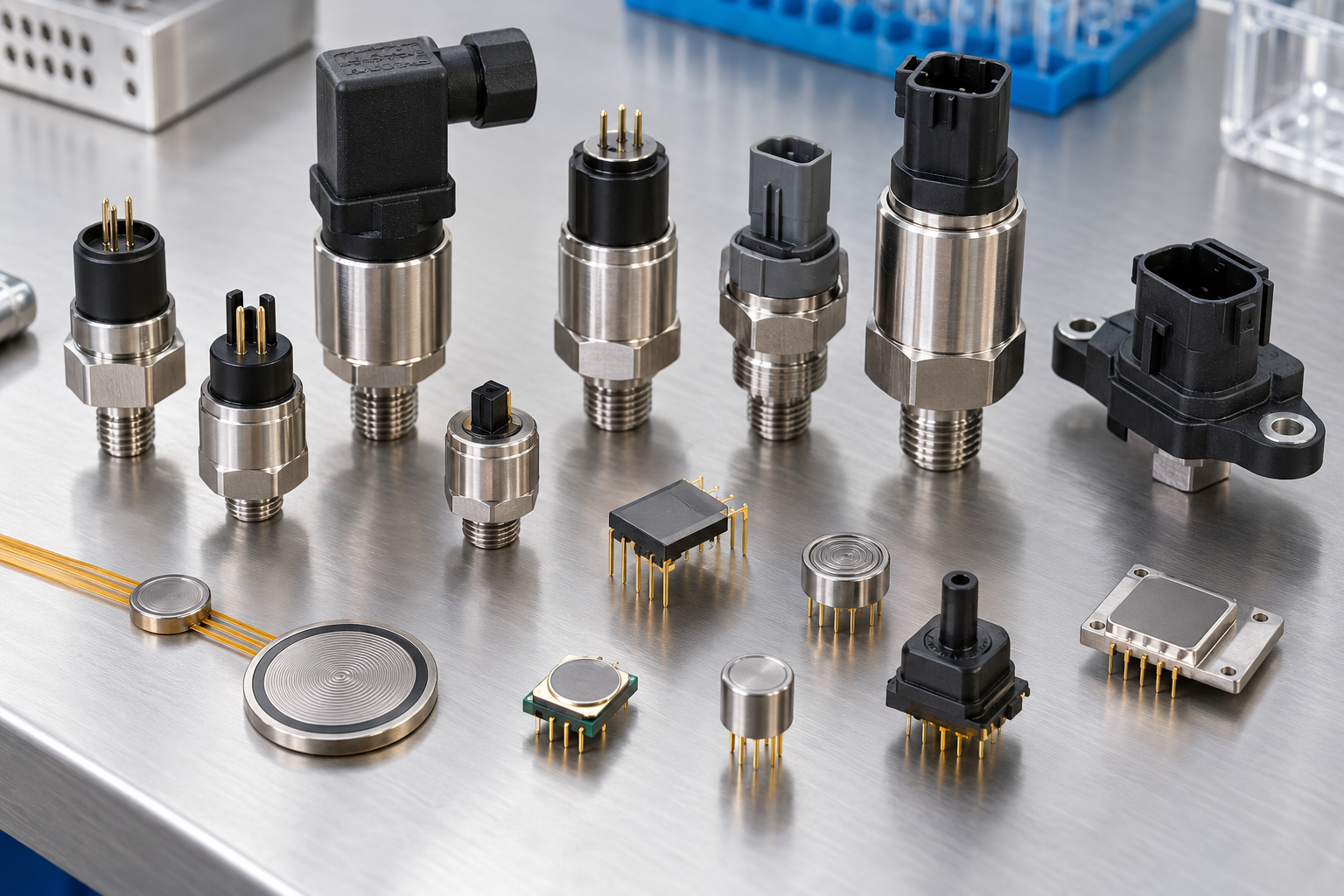
How do I choose a pressure sensor?
Quick answer: Pressure sensor selection starts with three gating specifications. First, confirm media compatibility: the wetted materials must survive your gas or liquid. Second, match the output type (mV, amplified voltage, 4–20 mA, or I²C/SPI) to your electronics. Third, size the overpressure limits (proof and burst pressure) above your worst-case spikes. Only then compare range, accuracy and package.
Think of the three gates like choosing a hose fitting. The material must suit the fluid (media), the connector must match your equipment (output), and the pressure rating must exceed your worst surge (overpressure). Miss any one and the part fails, no matter how good its accuracy specification looks.
Table of contents
In this guide
- How do I choose a pressure sensor?
- Gate 1: Media compatibility
- Gate 2: Pressure sensor output type
- Gate 3: Overpressure limits (proof and burst pressure)
- After the gates: range, reference, accuracy and package
- Pressure sensor manufacturers at CDI
- Pressure sensor FAQ
Related articles in this series (each links back to this pressure sensor selection guide)
- Wetted materials guide: 316L stainless vs. ceramic vs. silicon pressure sensors (back to Gate 1)
- mV vs. amplified vs. 4–20 mA vs. I²C pressure sensor outputs (back to Gate 2)
- Proof pressure vs. burst pressure: sizing for spikes and water hammer (back to Gate 3)
- Gauge vs. absolute vs. differential pressure sensors (back to After the gates)
- Total error band (TEB) explained for pressure transducers (back to After the gates)
- Low-pressure sensors for HVAC airflow and respiratory devices (back to Manufacturers at CDI)
Gate 1: Is the pressure sensor compatible with your media?
Media compatibility is the first gate in pressure sensor selection, because a sensor whose wetted materials react with the fluid will drift or fail no matter how accurate it is. "Wetted materials" are every surface the gas or liquid touches: diaphragm, port, die, seals and adhesives.
Ask three questions:
- Is the media a dry, clean gas or a liquid? Many board-mount MEMS sensors are rated for dry gas only. TE's MS4525DO is specified for "non-corrosive dry gases compatible with ceramic, silicon, borosilicate glass, RTV, gold, aluminum and epoxy."
- Is it corrosive, conductive or wet? Water, oils, fuels and refrigerants call for a media-isolated pressure sensor. These put a stainless steel diaphragm and oil fill between the fluid and the silicon die. SSI Technologies' P51 uses 304L and 316L stainless steel and is rated for water, hydraulic fluid, brake fluid, diesel, motor oil, hydrogen and nitrogen.
- Which port sees the media? In a differential sensor the two ports often have different media ratings. Connect the harsher media to the port rated for it.
| Media | Typical sensor construction | CDI example |
|---|---|---|
| Clean, dry air or gas | Board-level MEMS (silicon, glass, epoxy) | TE MS4525DO, Amphenol NovaSensor NPA |
| Water, oil, fuel, refrigerant | Media-isolated, 316L stainless steel | All Sensors SPA401, SSI Technologies P51 |
| Hydraulic or high-pressure liquid | Stainless steel transducer, sealed port | SSI Technologies P51 |
Analogy: the wetted materials are like the gasket in an engine. Pick one rated for the fluid, or it swells, cracks and leaks, regardless of how well the rest of the engine is built.
Gate 2: Which pressure sensor output type fits your system?
In pressure sensor selection, the output type must match what your controller can read, over the cable length you have. Board-level designs usually want I²C, SPI or a ratiometric voltage next to the MCU. Plant-floor installations usually want a 4–20 mA loop. The wrong choice adds amplifier, ADC or loop hardware, or leaves you with noisy data.
| Output type | Signal | Best fit | CDI example |
|---|---|---|---|
| Uncalibrated mV | Millivolt bridge output | Designs with their own amplifier and calibration | Amphenol NovaSensor NPA-100 |
| Amplified ratiometric voltage | 0.5–4.5 V (5 V supply) or 10–90% of supply | Direct input to an MCU ADC, short cable | NPA-300/500, SSI P51, All Sensors SPA401 |
| 1–5 V | Amplified voltage, 8–30 V supply | Industrial controllers | SSI P51 |
| 4–20 mA current loop | 2-wire, loop powered | Long cable runs and PLCs in noisy plants | SSI P51 |
| Digital I²C or SPI | 14-bit pressure, 11-bit temperature | Embedded boards, multi-sensor buses | TE MS4525DO, NPA-700/730 |
Two rules of thumb:
- Cable longer than a few meters, or near motors and drives? Choose 4–20 mA. Current is not affected by wire resistance the way voltage is, and 4 mA as "zero" makes a broken wire easy to spot.
- Sensor on the same PCB as the MCU? Choose I²C/SPI or ratiometric voltage. Digital output also removes ADC error from your error budget.
Analogy: output type is the plug on a power cord. A US plug in a European socket fails even though both carry electricity. Match the plug to the socket, or budget for an adapter.
Gate 3: How much overpressure can the sensor survive?
Size the sensor so your worst-case pressure spike stays below its proof pressure, not just its full-scale range. Pump starts, valve slams and water hammer can briefly hit several times the normal operating pressure. A sensor that sees one spike past proof pressure can carry a permanent offset for the rest of its life.
- Full scale (FS): the top of the range where the sensor meets its accuracy spec.
- Proof pressure: the maximum you can apply and still get back to spec once the pressure drops. Go past it and you get a permanent offset.
- Burst pressure: the point where the housing or diaphragm ruptures and the media leaks. Treat it as a safety limit, never as a design margin.
| Sensor | Proof pressure | Burst pressure | Source |
|---|---|---|---|
| SSI Technologies P51 (absolute / sealed gauge) | 2× FS (voltage outputs), 3× FS (4–20 mA) | 10× FS or 15,000 psi, whichever is less | P51 datasheet |
| SSI Technologies P51 (gauge) | 2× FS (voltage outputs), 3× FS (4–20 mA) | 3× FS | P51 datasheet |
| TE MS4525DO | Varies by range | 15–20 psi (1–5 psi ranges) up to 300 psi (100–150 psi ranges) | MS4525DO datasheet |
| Amphenol NovaSensor NPA | 5 psi (10 inH₂O to 1 psi ranges), 60 psi (5 to 30 psi ranges) | Not specified; 60 psi maximum package pressure | NPA series |
A quick sizing check:
- Measure or estimate the highest transient pressure, P_spike.
- Pick a range whose proof pressure is above P_spike, with margin.
- If that pushes full scale far above normal operation, you lose resolution. Add a snubber or restrictor to the port to soften the spike, then choose a lower-range sensor.
Analogy: proof pressure is a bridge's rated load, and burst pressure is the load that collapses it. You keep traffic under the rated load, not merely below the collapse point.
After the gates: what else matters in pressure sensor selection?
Once a pressure sensor passes all three gates, narrow the shortlist on pressure reference, range, total error band, temperature range and package. These specs separate a part that works from the part that fits your design best, and they are where most datasheet comparisons happen.
- Pressure reference: gauge (relative to atmosphere), absolute (relative to vacuum), differential (port A vs. port B) or sealed gauge. The MS4525DO comes in absolute, gauge, differential, compound and vacuum versions (TE).
- Pressure range: pick the smallest full scale that still clears Gate 3. Ranges at CDI run from 0.1 inH₂O on All Sensors' ultra-low-pressure MEMS parts (All Sensors) to 7,500 psi on the SSI P51 (SSI).
- Accuracy vs. total error band (TEB): accuracy is usually quoted at room temperature. TEB adds temperature and other error sources across the compensated range. For example, the MS4525DO is ±0.25% span accuracy but ±1% span TEB from −10°C to 85°C (TE). Design to TEB.
- Temperature range: check both operating and compensated ranges. The NPA operates from −40°C to 125°C, but it is compensated only from 0°C to 60°C (Amphenol).
- Package and port: SOIC surface-mount for PCBs (NPA), barbed ports for tubing, or a threaded NPT port for plumbing.
Pressure sensor manufacturers at CDI
Component Distributors Inc. (CDI) carries board-level, media-isolated and transducer-style pressure sensors from the manufacturers below, so one distributor can supply both the PCB-mount part and the plumbed transducer in a design.
| Manufacturer | Strength | Example product families |
|---|---|---|
| TE Connectivity (MEAS) | Broad board-level catalog with digital I²C/SPI outputs | MS4525DO |
| Amphenol NovaSensor | SMT MEMS with mV, amplified and I²C variants | NPA, NPC, NPP |
| All Sensors | Ultra-low pressure (0.1 inH₂O to 5 psi) and media-isolated lines | DLHR, ELV, MAMP, SPA401, CPA602 |
| SSI Technologies | Stainless steel, media-isolated transducers up to 7,500 psi with voltage and 4–20 mA outputs | P51 |
Next step: Send CDI your media, output and worst-case pressure. The applications team will work through pressure sensor selection with you and shortlist parts that pass all three gates.
Pressure sensor FAQ
What is the difference between a pressure sensor and a pressure transducer?
In everyday use the two terms overlap. "Pressure sensor" usually means the sensing element or a board-mount part. "Pressure transducer" usually means a packaged unit with a port and a conditioned output, such as the 0.5–4.5 V or 4–20 mA SSI P51. A "pressure transmitter" normally refers to a 4–20 mA loop device.
Can I use a dry-gas pressure sensor with water or humid air?
Not reliably. Dry-gas parts expose silicon, glass and wire bonds directly to the media (TE MS4525DO), and moisture or condensation can corrode bonds and shift the output. For water, condensing air or oil, use a media-isolated stainless steel sensor such as the All Sensors SPA401 or SSI P51.
What is the difference between proof pressure and burst pressure?
Below proof pressure, the sensor returns to spec. Between proof and burst, it may survive but shift permanently. At burst, the sensor ruptures and media can escape. The SSI P51 absolute version is rated at 2× FS proof (voltage outputs) and up to 10× FS burst (SSI).
Should I choose a 4–20 mA or a voltage pressure sensor output (0.5–4.5 V or 1–5 V)?
Choose 4–20 mA for long cable runs, PLC inputs and noisy industrial sites, because current holds up over wire resistance and a reading below 4 mA flags a broken loop. Choose ratiometric voltage (0.5–4.5 V) or I²C when the sensor sits close to the MCU on the same board and you want fewer parts. Choose 1–5 V when an industrial controller expects it and the cable is short.
Which pressure sensor works for low-pressure HVAC airflow or medical breathing devices?
Look at ultra-low-range MEMS parts built for air and dry gas. All Sensors offers ranges down to 0.1 inH₂O (All Sensors), and Amphenol NovaSensor NPA ranges start at 2 inH₂O in a surface-mount package (Amphenol). Differential versions read duct static pressure or flow across an orifice.
How do I choose between gauge, absolute and differential pressure sensors?
Use gauge when the reading should follow local atmosphere, as in tire or tank pressure. Use absolute for altitude or barometric readings, since it references a sealed vacuum. Use differential for filter loading, flow across an orifice or duct static pressure, where the difference between two ports is the measurement.
Sources
- CDI: Pressure Sensors & Transducers
- CDI: Board Level Pressure Sensors
- CDI: All Sensors line card
- TE Connectivity: MS4525DO datasheet (hosted by CDI)
- Amphenol Advanced Sensors: NovaSensor NPA series
- SSI Technologies: P51 pressure sensor datasheet
- All Sensors SPA401 media-isolated series (Sensor Tips)