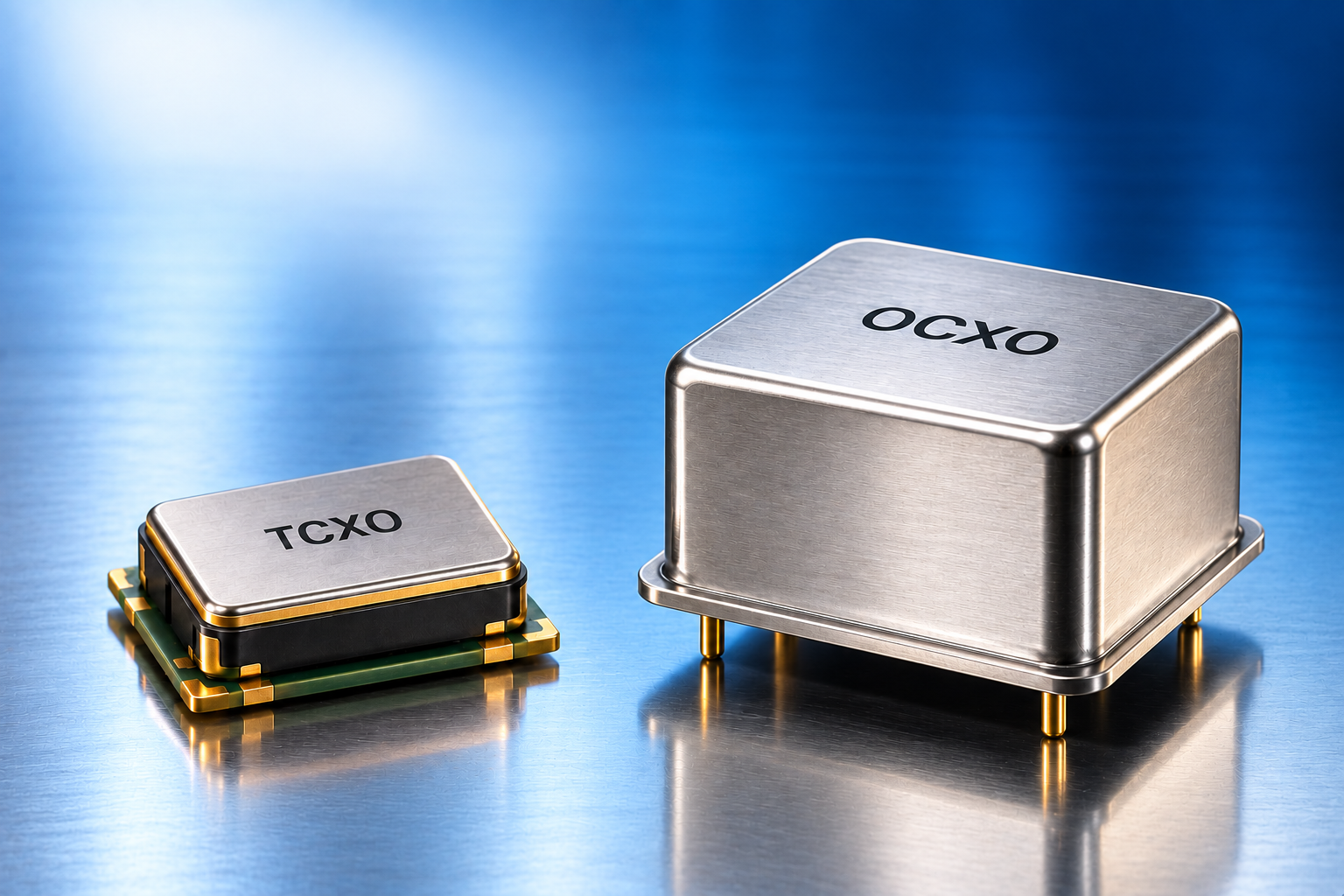
TCXO vs OCXO: the short answer
In the TCXO vs OCXO decision, pick a TCXO when power, size and instant start-up matter most, and pick an OCXO when stability over temperature and time is the requirement you cannot miss. The rest of this post helps you find where your design sits between those two poles.
Every radio, network switch and timing server runs off one reference oscillator. Its frequency error propagates to every clock and carrier derived from it. A 1 ppm error on a 10 MHz reference becomes a 3.5 kHz error on a 3.5 GHz 5G carrier, which can push a link outside its channel or break network synchronization.
An analogy helps: a TCXO is a quartz watch that corrects itself for temperature using a lookup table. An OCXO is a watch kept inside a small thermostat-controlled oven, so temperature never changes in the first place. The oven wins on accuracy, but it costs heater power, board area and minutes of warm-up before it is trustworthy.
What is the difference between a TCXO and an OCXO?
A TCXO measures the crystal's temperature and electronically corrects its frequency. An OCXO heats the crystal in a small oven held above the highest ambient temperature, so the crystal never sees a temperature change. Among the Taitien parts compared here, the oven delivers 20 to 50 times tighter stability (±10 ppb against ±0.2 to ±0.5 ppm), at the cost of power, size and warm-up time.
A quartz crystal's frequency drifts with temperature, and every oscillator family is a different answer to that single problem.
- XO (crystal oscillator): no correction at all. Cheap and tiny, but typically tens of ppm over temperature.
- TCXO (temperature-compensated XO): a sensor reads the temperature and a compensation circuit nudges the frequency back. Taitien's standard TX type holds ±0.5 ppm from -40 to +85 °C in a 3.2 × 2.5 × 0.9 mm package.
- VCTCXO: a TCXO with a control-voltage pin, so a PLL or GNSS receiver can steer it onto an external reference.
- OCXO (oven-controlled XO): the crystal sits in a heated chamber held above the highest ambient temperature. Taitien's NN miniature OCXO holds ±10 ppb from -40 to +85 °C, about 50 times tighter than that TCXO.
- Double-oven OCXO: an oven inside an oven for the most demanding holdover and test applications.
Five specs drive every selection. Learn to read them before comparing parts.
| Spec | What it means | Why it matters |
|---|---|---|
| Frequency stability vs temperature | Worst-case drift over the operating range (ppm or ppb) | Sets carrier accuracy and sync margin |
| Aging | Slow drift over days or years (ppb/day, ppm/year) | Decides how long the system can run without a GNSS or network fix (holdover) |
| Phase noise / jitter | Short-term timing wobble (dBc/Hz, ps rms) | Limits receiver sensitivity, EVM and data-converter SNR |
| Power | Steady-state and warm-up current | Drives battery life, thermal design and supply sizing |
| Warm-up time | Time from power-on until the output is within spec | Governs how fast a radio can come online after a cold start |
Note: 1 ppm = 1,000 ppb. A ±10 ppb OCXO on a 10 MHz output is off by at most 0.1 Hz; a ±0.5 ppm TCXO can be off by 5 Hz.
TCXO vs OCXO trade-offs: stability, power, warm-up and size
Moving from a TCXO to an OCXO buys about 20 times better temperature stability than the best TCXO here (±0.2 ppm vs ±10 ppb), and far lower aging. The price: a miniature OCXO takes roughly nine times the board area, draws heater power and needs time to warm up. The table below sizes each step with real Taitien parts.
| Part | Type | Package (mm) | Stability over temp | Aging / long-term | Power | Warm-up |
|---|---|---|---|---|---|---|
| TX type | Standard VCTCXO | 3.2 × 2.5 × 0.9 | ±0.5 ppm, -40 to +85 °C | – | Low (typical; supplies from 1.8 V) | Near-instant (typical for TCXOs) |
| TP-F type | Stratum 3 VCTCXO | 3.2 × 2.5 × 1.35 | ±0.2 ppm, -40 to +85 °C | ±4.6 ppm over 20 years | Low (typical) | Near-instant (typical) |
| TT type | Stratum 3 VCTCXO | 7.0 × 5.0 × 1.9 | ±0.28 ppm, -40 to +85 °C | ±4.6 ppm over 20 years; ±0.32 ppm over 24 h | Low (typical) | Near-instant (typical) |
| NN type | Miniature OCXO | 9.7 × 7.5 | ±10 ppb, -40 to +85 °C | – | Oven heater, higher than a TCXO (typical) | Minutes (typical OCXO) |
| NF-16M384-7000 | Ultra-low-power OCXO | 20 × 14 | ±10 ppb, 0 to +50 °C | 0.2 to 0.5 ppb/day | < 75 mW at 25 °C | 60 s |
| NF-10M-7000 | Ultra-low-power OCXO | – | ±10 ppb | 0.2 to 0.5 ppb/day | < 150 mW at 25 °C | 60 s |
What the numbers show:
- Stability: moving from the best TCXO (±0.2 ppm) to an OCXO (±10 ppb) buys roughly a 20× improvement over temperature, plus far better aging for holdover.
- Power: TCXOs run from a small bias current. Conventional OCXOs need heater power that peaks at start-up; Taitien's NF-7000 series was designed to cut that to under 75 to 150 mW depending on the model, which the company positions for battery-powered and ocean-bottom nodes.
- Size and warm-up: the smallest TCXOs are about 8 mm², while even a miniature OCXO is about 73 mm², roughly nine times larger, and it needs time before its output is trustworthy.
Before you commit: steady-state power and warm-up time depend heavily on ambient temperature and airflow. Confirm both at your worst-case cold corner with the vendor, not just at 25 °C.
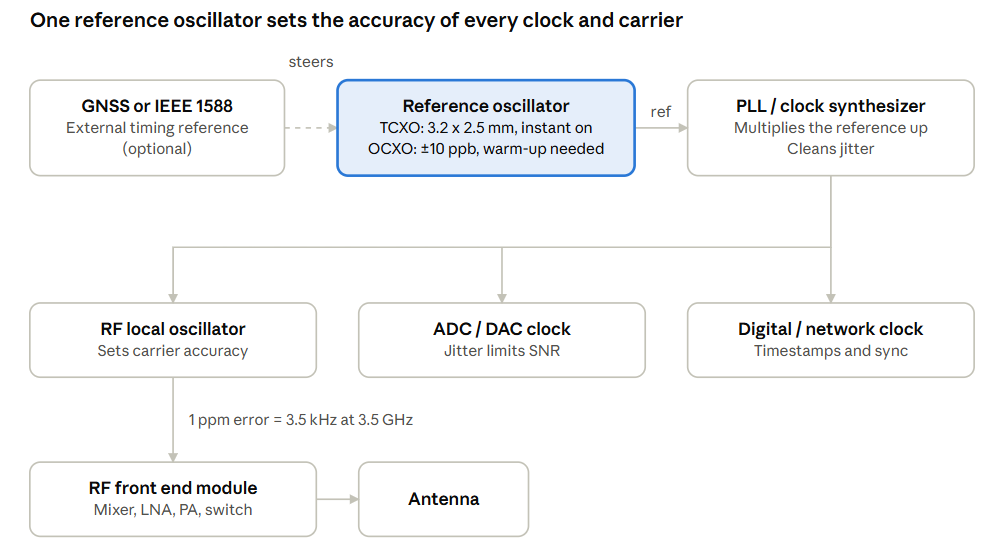
Where does the reference oscillator sit in an RF design?
The reference oscillator feeds a PLL, which multiplies it into the RF local oscillator, the data-converter clock and the digital clock. Any frequency error at the reference is multiplied along with it, so a small ppm error becomes kilohertz at the carrier. An optional GNSS or IEEE 1588 input can steer a VCTCXO, often letting a design skip the OCXO.
How do you save board space and power without losing stability?
Specify only the stability the system truly needs, and discipline a TCXO from GNSS or IEEE 1588 when you can. Move to a miniature or low-power OCXO only when holdover demands it. Then protect whichever part you choose with careful layout and a clean supply. The cheapest board space is the oscillator you never had to upsize.
- Budget stability from the system spec downward. Start from the requirement (for example, carrier accuracy, Stratum 3 holdover, or GNSS acquisition time) and subtract other error sources. If a Stratum 3 VCTCXO such as the 3.2 × 2.5 mm TP-F meets the budget, you avoid an OCXO footprint and heater supply entirely.
- Discipline a TCXO instead of buying an OCXO. A VCTCXO steered by GNSS or IEEE 1588 (PTP) timing holds long-term accuracy from the external reference. The oscillator only has to carry the system through short outages. This is the reasoning behind Taitien's Stratum 3 parts for base stations and femtocells.
- When holdover demands an oven, go miniature. Small cells and active antenna units push OCXOs into compact packages. Taitien's miniature OCXO line targets exactly those 5G designs and supports IEEE 1588 timing.
- Match power class to the power budget. For solar, battery or remote nodes, a low-power OCXO such as the NF-16M384-7000 (under 75 mW) may cost less in battery and thermal hardware than a standard oven.
- Protect the oscillator with layout. Stability on the datasheet assumes still air and a clean supply.
Layout rules that protect either part:
- Keep OCXOs away from airflow and hot parts such as PAs and regulators. Drafts force the oven to work harder and add frequency wander.
- Keep TCXOs away from fast-changing heat sources; compensation lags rapid temperature swings.
- Give the oscillator its own low-noise LDO and local decoupling. Supply noise shows up directly as phase noise.
- Route the output short and away from switching nodes, with a solid ground reference beneath.
- In vibrating platforms (vehicles, drones, aircraft), consider low g-sensitivity parts; Taitien lists low g-sensitivity TCXO and OCXO families for this.
TCXO vs OCXO selection checklist
Run this 11-point checklist at the architecture review, before the board footprint is locked. It turns the TCXO vs OCXO question into requirements you can measure: accuracy, holdover time, temperature range, start-up time, power budget, board area and layout keep-outs.
- Write down the frequency accuracy the system needs, in ppm or ppb, and where it comes from (standard, carrier, sync spec).
- Define holdover: how long must the system stay in spec without GNSS or network timing?
- Check whether an external reference (GNSS, IEEE 1588, SyncE) can discipline a VCTCXO instead of using an OCXO.
- Confirm the operating temperature range, including the cold-start corner.
- State the maximum allowed time from power-on to valid output, and compare it with OCXO warm-up.
- Set the oscillator power budget for steady state and for warm-up peak current.
- Pick the smallest package that meets the stability and phase-noise specs; compare 3.2 × 2.5 mm TCXOs first.
- Reserve keep-out space: no airflow path, PAs or regulators next to the oscillator.
- Give the oscillator a dedicated low-noise supply and short output route.
- For mobile or vibrating equipment, check g-sensitivity.
- Confirm availability and lead time with the distributor before committing the footprint.
TCXO or OCXO: which should you choose?
Choose the simplest oscillator that meets the spec. Use a disciplined TCXO when a timing reference is usually present, and an OCXO when long holdover or tight standalone stability is non-negotiable. Low-power and miniature OCXOs are narrowing the gap, so re-check old assumptions on every new design.
- TCXOs win on size, power and instant start; Taitien's best reach ±0.2 ppm in 3.2 × 2.5 mm.
- OCXOs win on stability and aging, around ±10 ppb, but cost area, heater power and warm-up time.
- Layout and supply design can waste a good oscillator; treat them as part of the selection.
For further study, Taitien's Application Notes and Timing Academy cover oscillator fundamentals. Standards to read next are Telcordia GR-1244 (Stratum levels) and IEEE 1588 (packet timing). Taitien parts are available in the US through CDI.
Frequently asked questions
Is a TCXO ever good enough for a base station, or does it need an OCXO?
Often a TCXO is enough, as long as GNSS or IEEE 1588 timing disciplines it. Taitien's TT type Stratum 3 VCTCXO complies with GR-253 and GR-1244 and holds ±0.32 ppm over 24 hours across industrial temperature. If the required holdover outlasts what a TCXO can carry, move to an OCXO.
Why does an OCXO miss spec for the first minutes after power-up?
The oven has not yet reached its set temperature, so the crystal is still drifting. Either hold off using the output until the oscillator reports ready, or choose a faster part. Taitien specifies a 60-second warm-up for its NF-7000 ultra-low-power series, far shorter than a conventional oven.
What is the smallest high-precision TCXO option?
Start with 3.2 × 2.5 mm parts. The TP-F meets Stratum 3 with ±0.2 ppm over -40 to +85 °C. If you need a higher output frequency directly, Taitien's high-frequency TCXO line covers 10 to 1500 MHz in the same footprint with 0.8 ps rms jitter.
Can an OCXO run on battery power?
It can if the power budget allows tens of milliwatts. Conventional ovens are a poor fit for batteries, but Taitien's NF-16M384-7000 draws under 75 mW at 25 °C and warms up in 60 seconds. Taitien targets it at ocean-bottom nodes, SATCOM, aviation and maritime systems, where long unattended deployments make power the limiting spec.
Does vibration affect TCXO and OCXO performance?
Yes. Vibration turns into phase noise through the crystal's g-sensitivity, which matters on vehicles, drones and aircraft. Taitien markets its 3.2 × 2.5 mm TP series with low g-sensitivity for GNSS, positioning and aerospace use. Ask for the g-sensitivity figure on the datasheet before you commit.
What should a product manager ask before choosing TCXO vs OCXO?
Ask three questions. What frequency accuracy does the spec actually require? How long must the product keep working without a timing reference? What happens to the user if the radio takes a minute to come online? The answers usually settle TCXO vs OCXO before anyone opens a datasheet.
Sources
- Taitien home: frequency control and timing solutions
- Taitien Ultra Low Power OCXO series announcement (NF-16M384-7000, NF-10M-7000)
- Taitien Miniature OCXO (NN type)
- Taitien Stratum 3 VCTCXO, TP type
- Taitien Stratum 3 VCTCXO, TT type
- Taitien Standard VCTCXO, TX type
- Taitien high-frequency VCTCXO and TCXO
- Taitien low g-sensitivity TCXO, TP type
Values marked "typical" are general guidance, not vendor-published figures. A dash means no figure is given here. Confirm with current datasheets before design-in.