
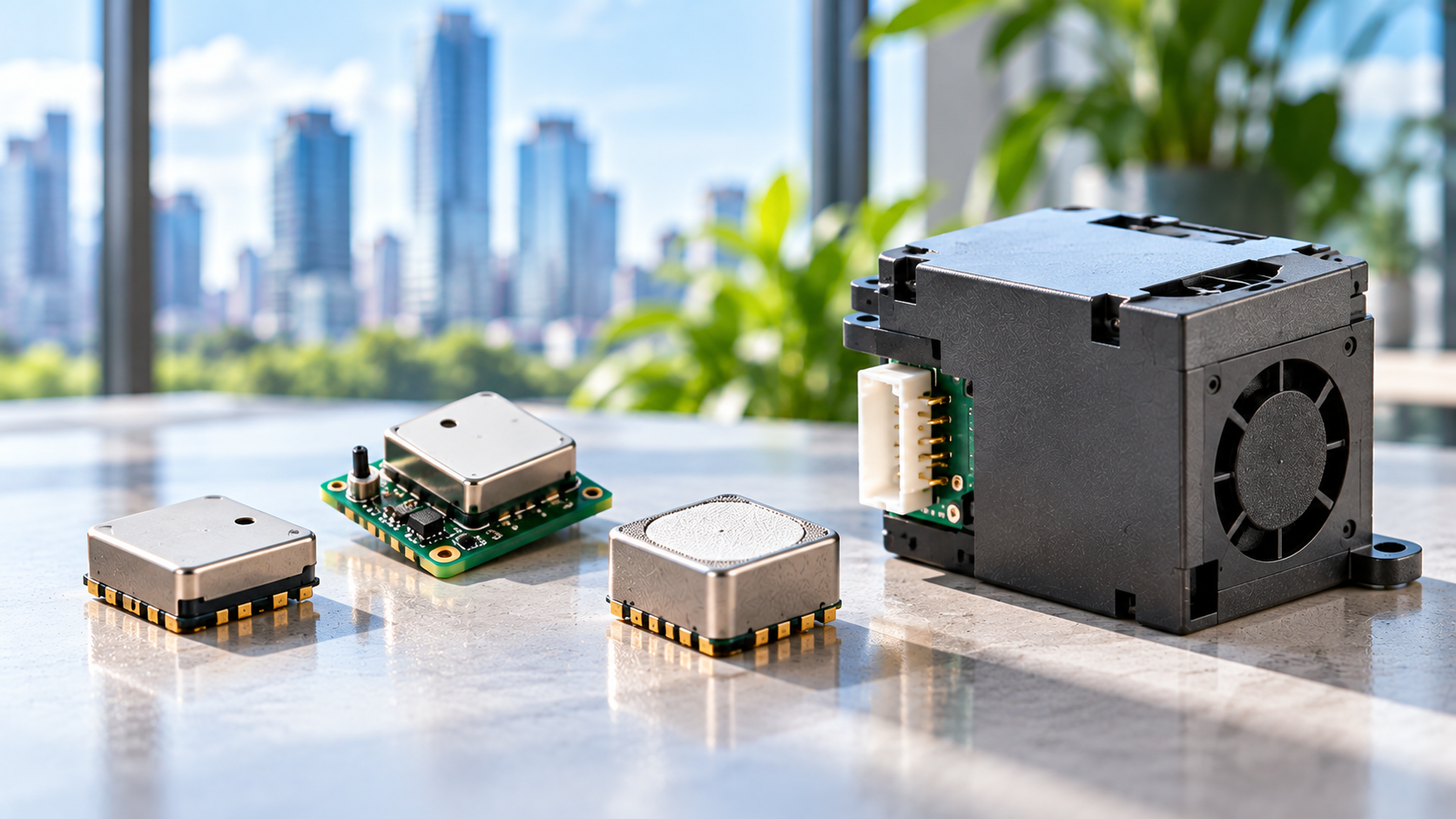
The right air quality sensor depends on what your product needs to measure. MOx tracks broad, VOC-based air quality at microwatt power. NDIR measures true CO₂. PID resolves VOCs to ppb levels. Electrochemical cells detect one toxic gas. Optical sensors count particles. Match the technology to that need first, then to your power and size budget.
The problem: "air quality" is not one measurement
You have been asked to add an air quality sensor to a product: a thermostat, an air purifier, a smart-building node, or a bathroom fan. The catalog search returns hundreds of parts, and they do not measure the same thing. Some report true CO₂, some report "eCO₂," some report TVOC in ppb, some report PM2.5 (airborne particles with a diameter of 2.5 micrometers or smaller), and some report a single toxic gas.
Pick the wrong technology and the product works exactly as designed while answering the wrong question: a ventilation controller that reacts to cleaning spray, or a "healthy air" indicator that never notices a room full of people. The right choice starts with what decision the reading will drive.
Why do air quality sensors disagree with each other?
Air quality sensors disagree because each technology exploits different physics, and indoor air contains several largely independent pollutant families. Occupancy raises CO₂ and human bioeffluents. Paint, furniture, adhesives, and cleaning products release volatile organic compounds (VOCs). Cooking, candles, and outdoor wildfire smoke add particles. Combustion appliances can add CO and NO₂. No single transducer sees all of these well.
Metal-oxide (MOx) sensors use a heated film, typically tin dioxide, on a MEMS micro-hotplate. At a few hundred degrees C, oxygen adsorbs on the surface and traps electrons, raising the film's resistance. Reducing gases such as most VOCs react with that oxygen, release the electrons, and the resistance drops. The response is broad and non-selective, which is exactly what you want for the question "is this air getting worse?" MEMS construction keeps the thermal mass tiny, so the heater can be pulsed and average power driven into the microwatt range. Modern parts add temperature-modulation profiles and trained algorithms to turn raw resistance into a TVOC value, an IAQ rating, and an estimated CO₂ (eCO₂). Think of MOx as a sense of smell: very good at noticing that something changed, not at naming the molecule.
eCO₂ is an inference, not a measurement. People exhale VOCs roughly in step with the CO₂ they exhale, so an algorithm can map the VOC signature to a CO₂-equivalent. It tracks occupancy well in ordinary rooms, but a non-human VOC source (a cleaning cart, fresh paint) will push eCO₂ up even though real CO₂ has not moved.
The other four technologies trade size, power, or service life for selectivity:
- NDIR (non-dispersive infrared) sensors measure real CO₂ by its absorption band near 4.26 µm. Selectivity is excellent, but Beer-Lambert absorption needs an optical path and an IR source, so the parts are larger and draw more power.
- Photoionization detectors (PID) use a UV lamp to ionize VOCs and resolve down to ppb levels, at higher cost and size.
- Electrochemical cells are selective for one target gas (CO, NO₂, O₃) but consume their electrolyte over time.
- Optical particle sensors count laser-scattered light from particles and measure no gases at all.
How do air quality sensor technologies compare?
MOx is the only option that is both millimeter-scale and microwatt-level, but it reports broad, VOC-based estimates. NDIR and electrochemical cells are selective for one gas. PID reaches ppb-level VOC sensitivity at the cost of a UV lamp. Optical PM sensors see only particles and usually need a fan. The table below compares the five technologies an engineer is most likely to shortlist for an indoor air quality design. Treat the entries as relative guidance; always confirm against the specific datasheet.
|
Technology |
Measures |
Selectivity |
Avg. power |
Size |
Best fit |
|
MOx (MEMS) |
TVOC, IAQ index, eCO₂ |
Broad |
µW to low mW |
mm-scale SMD |
Battery IAQ monitors, purifiers, HVAC, odor |
|
NDIR |
True CO₂ |
High (one gas) |
mW range |
Module |
Ventilation control where measured CO₂ is specified |
|
PID |
Total VOC, ppb level |
Broad, very sensitive |
Higher (UV lamp) |
Large |
Industrial hygiene, solvent and leak detection |
|
Electrochemical |
One gas (CO, NO₂, O₃…) |
High |
Very low |
Cell |
Safety alarms, outdoor AQI, combustion |
|
Optical PM |
PM1 / PM2.5 / PM10 |
Particles only |
mW range (fan) |
Module + airflow |
Smoke, cooking, wildfire infiltration |
How do you choose an air quality sensor?
Start with three questions:
- What action does the reading trigger? Ventilating for occupancy points to CO₂ or eCO₂; responding to odors and off-gassing points to TVOC; life safety points to a selective electrochemical cell.
- What is the power and size budget? A battery-powered wall sensor rules out anything that needs a fan or a lamp running continuously.
- Does a code, standard, or certification name the measurand? If a specification calls for measured CO₂, eCO₂ will not satisfy it. Many premium products combine two technologies, such as MOx for VOCs plus NDIR for CO₂, precisely because the answers differ.
Where do the SGX4410 and SGX6410 fit?
The Amphenol SGX Sensortech SGX4410 wins the case where you need broad, VOC-based indoor air quality in a very small, very low-power footprint: battery-powered monitors, air purifiers, HVAC controls, smart bathrooms, and wearables. It pairs a MEMS metal-oxide sensing element with SGX's pretrained machine-learning algorithms. The specs that matter for this problem:
- Outputs: TVOC concentration, IAQ rating per the German UBA guideline, eCO₂, and a fast relative IAQ index; alternate firmware adds absolute TVOC for Public Building Air Quality (PBAQ) and sulfur-odor discrimination.
- Power: down to 200 µW; supply range 1.7 to 3.6 V.
- Package: 12-LGA, 3.0 × 3.0 × 0.7 mm (0.9 mm for the IP67 water- and dust-proof version).
- Robustness: siloxane-resistant, auto-compensation for humidity, temperature, and oxidizing gases, −40 to +85 °C operation, and 10-year lifetime qualified to JEDEC JESD47.
Where it does not win: if your spec requires measured CO₂, pair it with an NDIR sensor. If you want processing off your host MCU entirely, look at the SGX6410, which builds on the same sensing platform and adds an on-board microcontroller with I²C and UART outputs.
Download the SGX4410 and SGX6410 data sheets
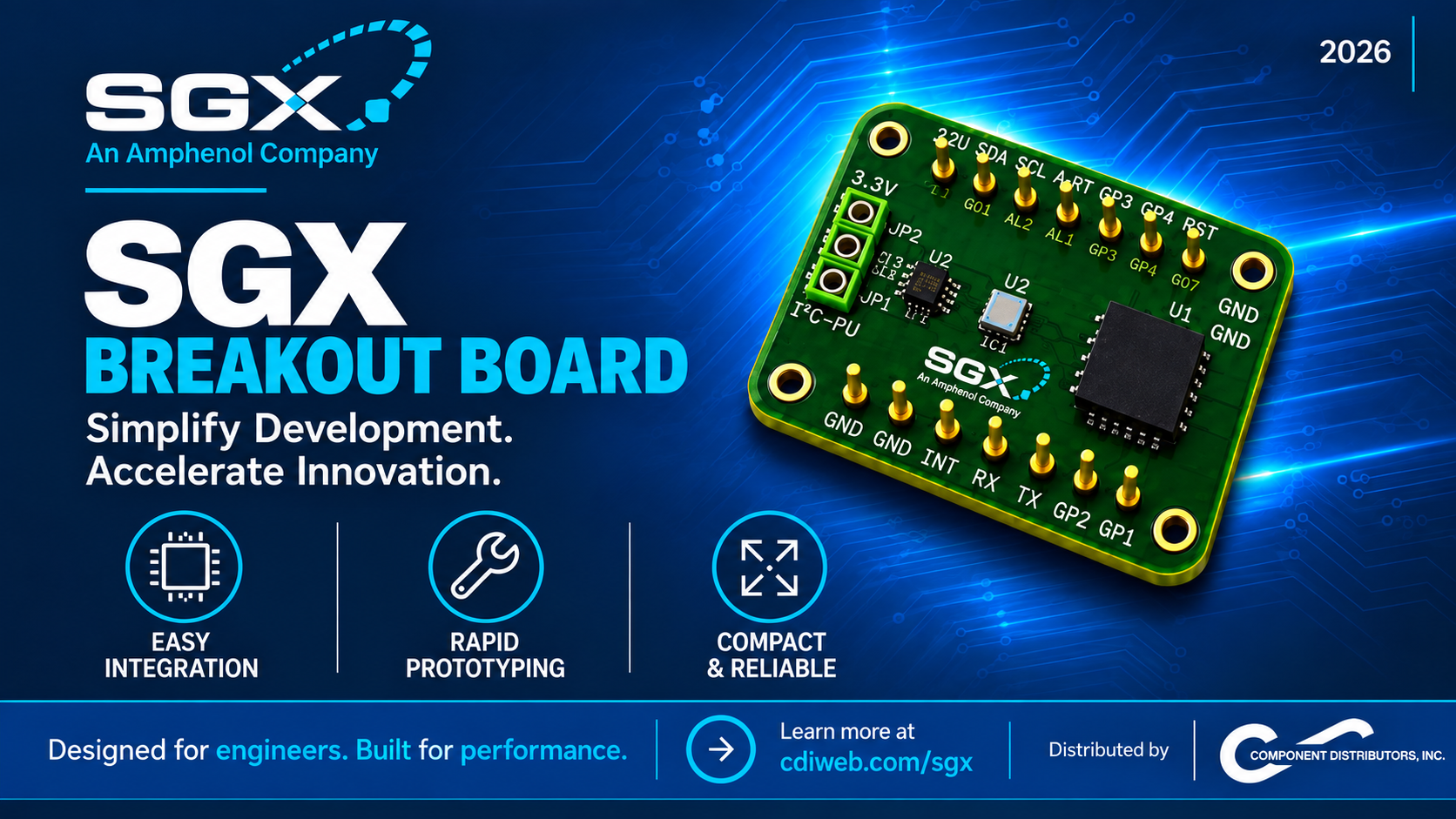
Want to try it before you design it in? Our SGX6410 breakout board lets you go from box to bench readings in an afternoon.
Worked example: Will a battery IAQ monitor last for 2 years?
Yes, if the rest of the system averages about 140 µW.
The design: a wall-mounted conference-room monitor running on two AA alkaline cells, reporting IAQ and eCO₂ over Bluetooth LE, with a two-year battery-life target.
The power budget works out in four steps:
- Energy available. Two AA cells in series give about 3.0 V × 2.5 Ah = 7.5 Wh (watt-hours), or 27,000 joules (J). Derate 20% for temperature, self-discharge, and end-of-life cutoff: roughly 21,600 J usable.
- Allowable average power. Two years is about 63.1 million seconds (Ms), so 21,600 J / 63.1 Ms ≈ 342 µW for the entire system.
- Sensor share. At 200 µW, the SGX4410 uses about 12,600 J over two years, around 58% of the budget, leaving about 140 µW for the MCU in sleep, periodic BLE advertising, and an e-paper refresh. Tight, but workable. By comparison, a CO₂ sensing path averaging 1.5 mW would need about 94,600 J, more than four times the usable battery energy.
- Supply. The 1.7 to 3.6 V range covers two AA cells from fresh (~3.2 V) to depleted (~1.8 V), so the sensor can run directly from the battery without a regulator and its quiescent losses.
Layout notes: keep the sensor away from regulators, radios, and backlights that create local heat; give it a direct vent to room air; and keep silicone adhesives and conformal coatings away during assembly. Confirm the lowest-power mode update rate meets your application and check the datasheet for first power-up conditioning time.
Ready to evaluate?
Request SGX4410 and SGX6410 samples or an evaluation kit from CDI at sales@cdiweb.com, and download the datasheet to start your power budget. See the full SGX Sensortech line from Component Distributors.
Frequently asked questions
Is eCO₂ the same as a real CO₂ measurement?
No. eCO₂ is estimated from the VOCs people exhale, so it tracks occupancy well but can read high when other VOC sources, such as a cleaning cart or fresh paint, are present. If a standard requires measured CO₂, use an NDIR sensor, either alone or paired with a MOx sensor for VOCs.
Can one sensor measure everything that affects indoor air quality?
Not reliably. Gases, CO₂, and particles need different physics, so no single transducer covers them all. Many products pair a MOx TVOC sensor with an NDIR CO₂ sensor or an optical PM sensor, letting each technology answer the question it is built for.
How long does a MOx air quality sensor last?
Modern MEMS MOx parts are designed for long service; the SGX4410 is qualified for a 10-year lifetime under JEDEC JESD47. Electrochemical cells, by contrast, consume their electrolyte and have a shorter, finite life, which matters for products expected to run for years without service.
What is the difference between MOx and NDIR sensors?
A MOx sensor uses a heated metal-oxide film whose resistance drops when VOCs react with it, giving a broad, low-power read on whether air is getting worse. An NDIR sensor measures CO₂ directly by its absorption band near 4.26 µm. MOx is smaller and runs on microwatts; NDIR is selective but larger and draws milliwatts.
Which air quality sensor is best for battery-powered devices?
A MEMS MOx sensor is usually the best fit, because it averages microwatt-level power in a millimeter-scale package. Anything that needs a fan or a lamp running continuously, such as optical PM or PID, drains batteries quickly. In the worked example, a 1.5 mW CO₂ sensing path would need more than four times the usable energy of two AA cells.